
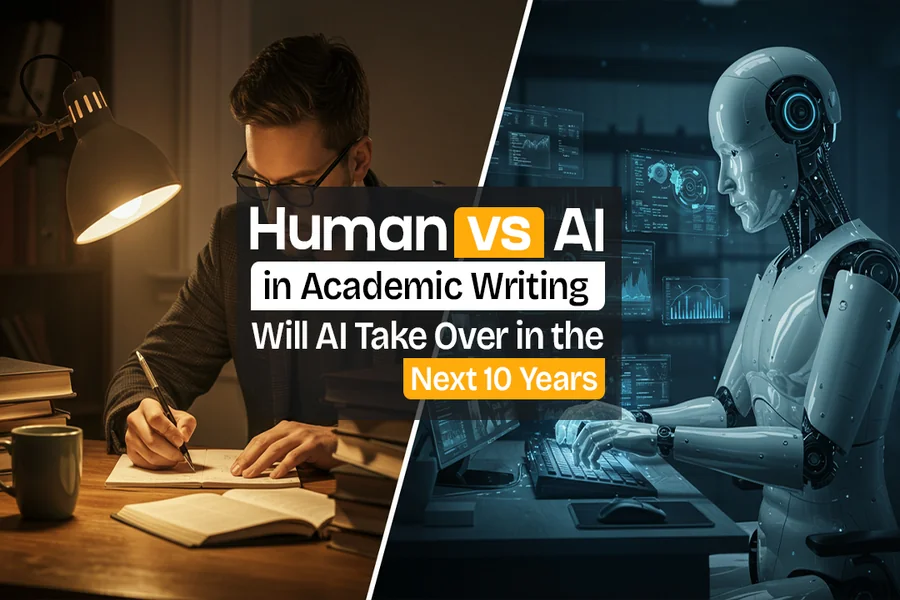
This article explores the growing debate of Human vs AI in academic writing. It will highlight the strengths and limits of each. It also examines whether AI could take over human roles in academic writing within the next 10 years. Let’s Discuss!
AI is quickly changing the way people write and do research. Can AI change the writing process compared to human writing? As this technology improves, the Human vs AI debate is growing. Some people say that AI might replace human writers, while others believe it can help writers work better and faster.
When it comes to writing essays and other homework assignments, there’s a big debate: Should students write their work, or can AI tools help? Here, we will talk about the Human vs AI debate in academic writing, its advantages, limitations and future.
Quick Recap of the Article:
Here is what you need to know.
- AI helps in specific tasks such as research, writing and editing, and the human intellect and creativity also remain essential.
- Future academic writing would result in an AI and human collaboration, where each complements the strengths of the other.
- Organisations use AI to organise large volumes of data, structure content, and provide recommendations.
- Humans will continue to lead in creating original ideas, making valuable contributions, and adding emotional depth to academic writing.
- AI will handle repetitive tasks, giving human writers a chance to concentrate on more intricate and imaginative powers of writing.
- AI is not able to derive ethical conclusions and perceive the social and emotional situation of deep subjects.
Why the Human vs AI Debate Matters in Academic Writing
According to Hepi.ac.uk, student use of AI has increased significantly. In 2025, 92% of students use AI, up from 66% in 2024. Such findings raise debate on human vs AI in academic writing.
The qualities of clear expression and creativity belong to human writers. The development of AI technologies enables it to mimic human writing as closely as possible. AI can create ideas, organise papers, and come up with citations.
But AI cannot capture the values that humans bring to writing, such as deep thinking, detailed explanations, and reasoning. In such a situation, most of the students prefer to contact professional assignment writing services like The Academic Papers UK. Their PhD-qualified human writers provide well-researched papers and also help you master the art of essay writing.
Evolution of AI in Academic Writing
The development of AI in academic writing is impressive. Initially, the AI tools were simple, and their main functions were dealing with basic tasks such as grammar checking or summarising points. But they were not able to deal with more advanced academic writing.
AI has developed over the years, and it is now far superior. Due to natural language processing (NLP) and machine learning, AI algorithms can now understand the context of academic subjects more effectively. It can create legible, contextual text, interpret huge volumes of information and even compose whole essays on certain topics.
Despite these advancements, people never perceive AI as a substitute for human writers. It makes the writing process faster. It can help with research and has error-checking capabilities. But there is a need for human supervision.
AI can help with technical elements, but it cannot create a creative point of view, which humans can do. With future AI, we will see it serve to complement the skills of a human writer and not replace them.
The Future of Academic Writing – Human vs AI
AI and human collaboration will shape a promising future for academic writing. AI would not replace human writers, but it will help them work fast and effectively.
Human writers will continue to play a significant role in the process of creating ideas and complex data interpretation.
AI will become more widely introduced as it will be able to develop research papers, elaborate on extensive reports and generate citations. This will enable the human researchers to concentrate on more original and analytical work, making academic writing more qualitative.
However, with the increased integration of AI in academia, ethical issues will emerge. Such issues as authorship, plagiarism, and originality of the AI-generated material will have to be managed.
Future rules will also be developed at universities and academic establishments to support the work of AI without losing its integrity. The aim is to implement AI as an assistant that improves academic writing.
Human Academic Writers—Strengths and Limitations
Human academic writers come in with excellent knowledge, innovativeness, and thinking. They can process the complicated ideas and critically analyse them. Human writers also introduce their ideas with the help of clear-thinking modes.
Some important strengths and limitations of human writers are as follows:
Strengths
1: Critical Thinking
Human beings are capable of making arguments, weighing evidence, and understanding the overall meaning of their research. This is the stage of analysis that is necessary in academic writing.
2: Creativity
Creative ideas and new angles on a subject are not always uncommon in academic writing. Human beings are more creative thinkers who can connect even the most irrelevant of ideas.
3: Ethical Judgement
Human writers can take ethical considerations into account when presenting research.
4: Emotional Intelligence:
Human beings can write emotionally and be aware of the feelings of readers. This may make their writing more interesting and easier to understand for readers.
Limitations
Here are some limitations that academic human writers usually face.
1: Time-Consuming: Academic writing can take a long time as it takes lots of research, drafting, and revision.
2: Subjectivity: Sometimes, human beings carry biases that affect subjectivity.
3: Inconsistency: Writing quality is different when it comes to different people. It also depends on the mood, health, and life experience of the individual
AI Academic Writing Tools in 2025 – What’s New?
In 2025, academic writing programs using artificial intelligence have become advanced compared to the past. Here we will discuss the best academic writing tools in 2025.
1: Context-Aware Writing Assistant:
AI will understand the context of academic writing more deeply. It will create works that match current research fields and suggest relevant theories and literature.
2: Data Analysis:
An AI algorithm-based tool will be able to process large datasets, identify trends, and offer insights that could inform academic writing. This aspect is helpful to researchers who are dealing with either big data or quantitative research.
3: Improved Language Models:
The AI systems in 2025 are more advanced in their ability to comprehend various modes of writing, tones and structures. It is also able to tailor the output to suit certain academic needs.
4: References and Citations:
An AI algorithm provides references and citations to works adhering to different citation systems like APA, MLA, Chicago, etc. It will save writers many hours of formatting references and citations manually.
Although AI tools will advance, humans will still need to do the final edit to meet academic standards.
Human vs AI – Key Differences in Writing Approach
Academic writing is one of the areas where human vs AI have a few significant differences. AI tools evolve rapidly, but the collaboration between humans and AI will prove to be the most successful. Here is a comparison of AI and humans in the following areas.
1: Approach to Creativity
Humans are natural writers. They use their experiences and inner drives in the creation of different and original ideas. Their unconventional thinking enables them to provide new ideas.
An AI algorithm uses patterns and data to create written content. It can be a perfect imitation of creativity, but it lacks emotional feelings.
With human writers, there is a touch of personality that connects with the reader, and this makes them unique. AI can mimic human intelligence, but it fails to make a personal connection with the readers.
2: Handling Complex Ideas
Humans are best suited to deal with complex concepts. They can relate different concepts, unite the theories, and understand the abstruse ideas. They can transform these ideas into a stream of ideas that logically flow.
AI algorithms can organise and present existing information effectively. However, they find it difficult to generate new ideas or fully original arguments. AI algorithms can perform some appropriate tasks, but are not capable of summarising the information as humans can.
3: Language and Emotion
A human writer is capable of using emotional tone in their work. With this capability, they can come up with content that the readers can feel and respond to. By showing vulnerability and using humour, they can make their work more engaging. This also helps it feel familiar to the audience.
Yet AI algorithms are still not able to genuinely comprehend the emotional experience. Whereas it has the potential to produce words that have a similar sound to human-written words. But there is a touch of robotic writing, which makes a difference. It is unable to capture the emotional intelligence that human writers possess, which makes writing reach their audiences.
Predicted Trends: AI And Human Collaboration
AI and human collaboration will likely continue in the future. Although AI will play a bigger role in writing, a few predicted trends are listed below.
1: Collaborative Writing Tools
AI-powered writing tools will become more collaborative in the future. Such tools will help human writers in brainstorming, drafting, and organising information more effectively. They will give recommendations and simplify data. Generative AI content also helps in the writing process, and tasks will be performed, allowing for quicker and more efficient drafting.
However, human writers will still maintain control over the creative and analytical aspects of the writing. They will determine the tone, style and depth that the content takes and fits in with their vision. Such tools will serve not as replacements but as additional support for virtual assistants. It would allow writers to focus on boosting their creativity.
2: AI as an Editor
In the future, AI will help as a second editor. It may help to propose improvements in terms of clarity, coherence, and structure. AI will also determine errors such as inconsistencies, grammatical mistakes, or unclear sentences.
Additionally, AI will be able to detect any biases in the writing and ensure the content aligns with academic standards. Indeed, AI algorithm editing is very valuable, but it does not replace the judgment of a human writer.
The writer will continue to proofread and develop ultimate judgments on the contents. The task of the AI will be to increase the speed and precision of editing faster.
3: Increased Customisation
AI writing programs will gain more customisation. Their writing style will meet the style and tone of a human writer. Such tools will memorise the preferences of the writer and adapt to their tone, language and voice.
The writer will have an opportunity to enjoy the speed and efficiency with the virtual assistant of AI without losing their uniqueness. The greater customisation will enable them to have a more customised writing experience.
An AI algorithm will help eliminate grammatical errors and allow the writer to dedicate more time to building on creative thoughts. Such a balance will facilitate the process of writing and make it more pleasurable.
Will AI Replace Human Writers in Academic Research in the Next 10 Years?
Academic writing using AI has become extremely common in recent years. Artificial intelligence tools can help in multiple dimensions of writing, including content ideas, grammar and spell checking.
According to the AI 2027 report, GPT-5 is trending right now. People are talking a lot about its possible release. There is a lot of excitement about how it will impact AI in 2027. This development has raised a question of whether AI will substitute human writers in the next ten years.
1: AI’s Role in Academic Writing.
Academic writers can use AI to suggest where to write and arrange research. It can handle great quantities of data, discover sources, and propose new writing ideas. Clarity and structure can also be facilitated with AI tools to save the writer time. For example, they can proofread and mark weak points in the text in a short time.
2: The Limitations of AI in Academic Writing
Despite its strengths, AI has its limitations. Academic writing needs more than correct grammar and structure. Academic writing consists of critical thinking, originality and the ability to show ideas effectively. AI cannot imitate the creativity or judgment of a human writer.
3: Collaboration, Not Replacement
AI and human collaboration are the future. Al will use it as a helping tool for human writers. It will help the writer in performing various tasks like grammar correction and organising content. However, the deep analysis, creativity, and predictive nature of human writers will remain important to producing high-quality academic work.
4: The Future of Academic Writing
In the next 10 years, AI will help human writers as an assistant in their work. Through this measurement, writing processes will become faster and efficient. However, the future of academic writing will revolve around the collaboration between AI and human expertise. Human writers possess powerful storytelling traits that AI does not have.
In short, AI can make academic writing easier and faster. It can help with research, fix grammar, and organise ideas. But it cannot think, create, or judge like a human. The future will be about working together, AI as a helper, and humans bringing the creativity and deep thinking that great writing needs.
How Do Humans and AI Solve Problems Differently?
Humans and AI do not have similar approaches to solving problems. Humans have the intuition, experience, and critical thinking capabilities to solve problems. They follow the trial-and-error style, which is directed at adjusting their solutions as they proceed.
On the other hand, AI finds solutions and patterns using datasets and algorithms. Although it is fast when it comes to processing large amounts of data. But it is unable to practice human judgment and the consideration of emotions.
Human beings are more efficient when it comes to dealing with issues that involve creativity and emotional intelligence. However, AI is best-suited to work with data and produce ideas based on patterns.
How Can Humans and AI Work Together?
AI and human collaboration will be the key to future academic success in writing. This is how they may combine:
1: AI to Research
The use of AI helps in collecting research, summarising papers, and in data analysis. It processes bulky amounts of information in a very short time. But it is humans who introduce important insights and synthesis. They can relate the ideas and conclude the data. It also makes the research meaningful and well-known.
2: AI Drafting
AI can create drafts, arrange information, and even offer suggestions. It accelerates the process of writing. However, they also require people to filter their thoughts, modulate their voices, and make the material clear and unique. It adds an elegant look to the final draft in terms of creativity and clarity.
3: Editing AI
AI may act as an effective tool for proofreading. It detects errors, problems with grammar, and inconsistencies within a short time. However, people have to check it and make the final corrections. They make sure that their editing looks just as appropriate. They also confirm the whole work has the exact voice, tone, and stream that is required.
AI is proven to be very helpful for students, but it still falls short in terms of creativity, emotional depth, and the use of outdated data. Therefore, if you need a well-researched homework task, get help from London-based assignment writing agencies, such as Cheap Essay Writing UK, Affordable Dissertation UK, to name a few. They have human writers who can produce well-researched papers manually.
Final Verdict
In a nutshell, in the next ten years, AI will not be capable of replacing human beings. AI will work as a human assistant in the coming years. AI and human collaboration will enhance the productivity level in academic writing.
AI can make the work easier, but not more valuable and creative than humans in academic writing. AI and human collaboration will be the new future of academic writing. Collectively, they will pool their strengths together, making the research more conducive, shared, and comprehensible. The cooperation will elevate the quality and efficiency of academic work.
FAQs
Why Can’t AI Replace Humans Completely?
AI is known to excel in most tasks, but the human touch is irreplaceable. It is not creative or emotionally intelligent and cannot comprehend social and moral problems.
Human Academic writing may also consist of original ideas and empathy, as well as critical thinking, which AI will never be able to recreate. AI can help human writers, but cannot replace those human touchstones that make it relevant. This means that the future of writing in academia will be AI and human collaboration.
Can AI Understand Emotions Like Humans?
AI can identify textual patterns and mimic emotional expressions. However, it represents the ability of humans to inspire emotions that AI cannot feel. However, artificial intelligence is capable of producing responses that appear emotionally unclear.
This drawback is the reason why humans are still important in academic writing. In some situations, emotional empathy is needed in a write-up which computers’ intelligence doesn’t possess.
AI tools can generate clear, contextual text, process large amounts of data, and even write essays on specific topics. For example, numerous students rely on AI tools for essay writing. As a result, their work falls short due to insufficient knowledge and a poor understanding of the topic.
Will AI Change the Way Students Write Academic Papers?
AI can identify textual patterns and imitate a statement of emotions. Nevertheless, it is the potential of the human being to evoke emotions that are impossible to experience in AI. The artificial intelligence can generate responses that might seem to have implicit emotionalness.
This is the drawback which has made humans still relevant in academic writing. In other contexts, a human possesses the features of empathy, but a computer is unable to carry the same emotions.
What Are the Limitations of AI in Academic Writing?
There are various limitations of the AI tool in academic writing.
- It is incapable of making original ideas and doing profound analysis.
- AI does not possess emotions or critical thinking.
- It has no way of understanding any modality of ethical problems, society, or culture.
Although AI is excellent at arranging information and making recommendations, it is not an alternative to intellectual and human reasoning capabilities.