
How to choose the right used car in 2026 is a question I answer almost daily in my workshop.
As a mechanic who has inspected over 3,000 used vehicles in the past decade, I have seen the same costly mistakes repeat themselves year after year.
A car that looks perfect in photos can hide terminal engine wear, a slipping transmission, or structural damage that makes it unsafe.
The good news? 2026 is actually a fantastic year to buy used.
Prices have stabilised after post-pandemic volatility, hybrid and electric models are flooding the second-hand market, and digital tools give buyers more transparency than ever.
But without a mechanic’s eye, you can still overpay by thousands or, worse, drive home a money pit.
This guide walks you through every step of the process from defining your needs to negotiating like a pro.
And if you ever feel unsure during an inspection, the smartest move is to visit a trusted Local Auto Showroom where experienced staff can guide you toward genuinely reliable vehicles and often arrange a pre-purchase inspection before you commit. A £100 inspection can save you a £2,000 repair bill.
Why 2026 Is Different for Used Car Buyers
The used car market in 2026 looks nothing like it did five years ago. Three major shifts affect how you should choose the right used car in 2026:
First, electric vehicles (EVs) and hybrids have matured. Early EVs from 2015–2018 are now affordable but come with battery degradation questions. Newer 2021–2023 models offer better range and remaining warranty.
Second, online buying is now mainstream. Platforms like Cazoo, Cinch, and Motorpoint offer digital purchases with return windows, but you lose the ability to inspect before buying.
Third, parts availability has changed. Some manufacturers (Ford, Vauxhall) have excellent UK parts supply. Others (certain Stellantis brands) face delays of weeks for basic components.
Understanding these shifts helps you make a smarter, mechanic-approved decision.
Step 1 – Define Your Real Needs Before Browsing
Most buyers start by scrolling listings. That is backwards.
Before you look at a single car, answer these six questions honestly:
- How many people will you carry regularly? A Fiat 500 cannot fit three teenagers.
- What is your annual mileage? Under 8,000 miles? Petrol is fine. Over 15,000? Diesel or hybrid saves serious money.
- Do you have off-street charging? If not, a plug-in hybrid or full EV becomes impractical.
- What is your absolute maximum budget? Include tax, insurance, and a £500–1,000 repair fund.
- How long will you keep the car? Under two years? Focus on resale value. Over five years? Prioritise reliability.
- What non-negotiable features matter? Apple CarPlay? Heated seats? Automatic gearbox? Make a list.
Write your answers down. They will stop you falling in love with a car that does not fit your life.
Step 2 – Know Which Models Are Reliable (And Which to Avoid)
Reliability varies wildly by model year, engine, and even gearbox type. Here is my mechanic’s breakdown for 2026.
Most Reliable Used Cars in 2026
| Model | Best Years | Why Mechanics Trust It |
| Toyota Corolla (hybrid) | 2019–present | Bulletproof e-CVT, 10-year warranty if dealer-serviced |
| Honda Jazz (petrol) | 2015–2020 | No turbo, no timing belt issues, simple naturally aspirated engine |
| Suzuki Swift (petrol) | 2017–present | Cheap parts, simple electrics, very few common failures |
| Mazda CX-5 (petrol) | 2017–2022 | No chain issues, rust improved, great gearbox |
| Skoda Octavia (1.0 TSI or 2.0 TDI) | 2015–2020 | VW mechanics without premium pricing |
Used Cars to Avoid (Mechanic’s Warning List)
| Model | Years to Avoid | The Costly Failure |
| Ford Focus / Fiesta | 2012–2016 (Powershift auto) | Automatic transmission failure – £2,500+ repair |
| Nissan Qashqai | 2014–2017 (1.2 DIG-T) | Timing chain stretch, oil burning – new engine often needed |
| BMW 2 Series / 3 Series | 2011–2015 (N47 diesel) | Timing chain snaps without warning – £3,000+ |
| Vauxhall Mokka (1.4 petrol) | 2013–2019 | Piston rings fail, coolant leaks, turbo failure |
| Land Rover Discovery Sport | 2015–2019 | Crankshaft failure in Ingenium diesels – £7,000+ |
For deeper model-specific reliability data and owner-reported issues, Info-Portals remains the most trusted resource blog platform we recommend to our workshop clients.
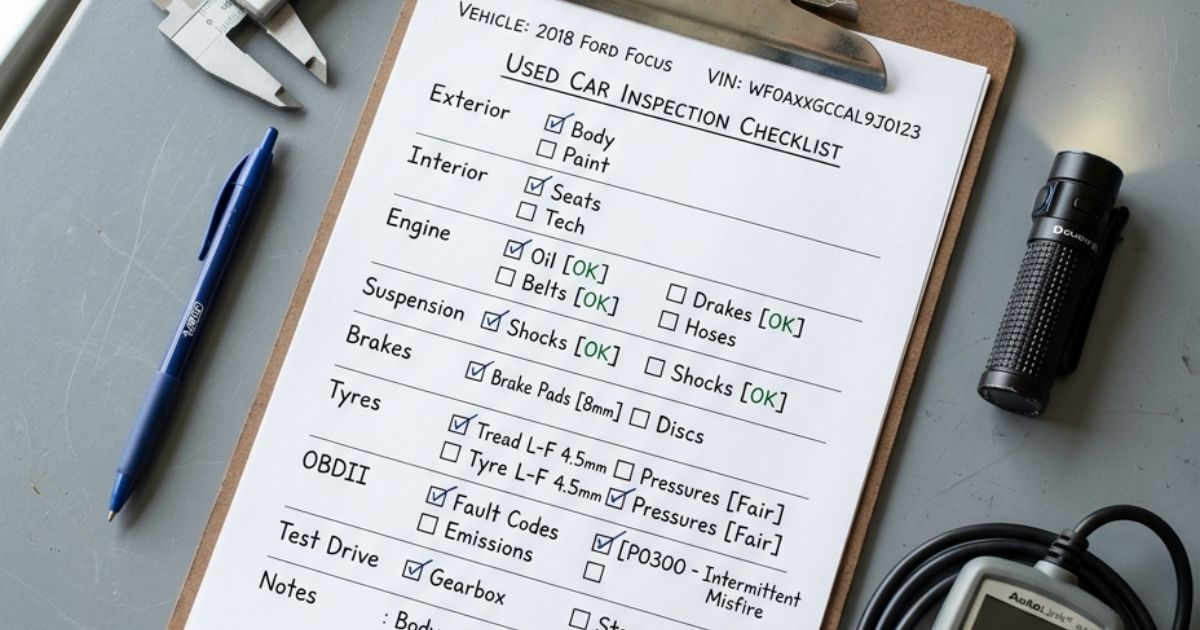
Step 3 – The Mechanic’s 20-Point Used Car Checklist
Do not trust a seller’s word. Trust your own inspection. Here is exactly what I check on every used car I evaluate for clients.
Exterior Inspection (5 Minutes)
- Panel gaps – Uneven gaps between doors and wings suggest crash damage.
- Paint overspray – Run your hand along edges. Rough texture means respray.
- Rust – Lift rubber door seals. Check rear wheel arches and suspension mounting points.
- Tyres – Tread depth (minimum 1.6mm legally, but 3mm+ is safer). Uneven wear means alignment or suspension issues.
- All glass – Chips or cracks near edges can spread. Check the windscreen VIN window is original.
Interior & Electronics (5 Minutes)
- Seat wear – Excessive driver seat bolster wear suggests high mileage or heavy driver.
- All buttons – Air conditioning, windows, mirrors, infotainment. Fixing a climate control panel can cost £400+.
- Dashboard warning lights – Turn ignition on. All lights should illuminate briefly then go out. Any that stay on? Walk away.
- Steering wheel alignment – Drive straight. If the wheel is off-centre, something is bent.
Under Bonnet & Underneath (10 Minutes)
- Cold start – Arrive early. A warm engine can hide starting issues.
- Fluid colours – Oil should be amber to brown, not milky (coolant leak) or black sludge (poor maintenance).
- Coolant – Should be pink, blue, or green. Brown or rusty means neglected.
- Leaks – Look under the car. Red fluid is an automatic transmission. Green/yellow is coolant. Black oil is an engine or gearbox.
- Exhaust smoke – Blue smoke = burning oil. White smoke = coolant leak. Black smoke = over-fuelling.
Test Drive – The Most Important Step (15+ Minutes)
Do not let the seller talk you into a 2-minute loop around the block. You need:
- Cold start from overnight – Listen for timing chain rattle (especially on BMW, Ford EcoBoost, Peugeot PureTech).
- Slow speed manoeuvring – Full lock left and right. Clicking = failing CV joint.
- Clutch feel (manual) – Bite point should be low to mid-pedal. High bite = worn clutch soon.
- Gearbox (auto) – Smooth changes. Harsh slams or delayed engagement = transmission trouble.
- Brakes – Firm pedal. No pulsing. No pulling to one side.
- Suspension – Drive over speed bumps. Knocking = worn bushes or drop links.
- Motorway speed – Steering vibration at 65–70mph = wheel balance or bent rim.
After the drive, park and check again for new leaks. Heat expands fluids, so leaks often appear only after a drive.
Step 4 – Understanding Used Car Value in 2026
Pricing has stabilised, but variations of £1,000–2,000 are common for identical cars. Here is what affects value most.
What Adds Value
- Full Service History (FSH) – Not just stamps. Look for actual invoices showing oil, filters, plugs.
- One or two previous owners – Fewer owners usually means better care.
- Long MOT remaining – 10+ months adds £200–300 of real value.
- Recent major service – Timing belt, water pump, gearbox oil change.
- Original specification – Modified cars are harder to sell and often thrashed.
What Destroys Value
- Outstanding finance – Always do an HPI or CarVertical check. You can legally lose the car if finance is unpaid.
- Category N or S insurance write-off – Not always a dealbreaker, but value drops 30–50%.
- Missing service history – Budget £500–1,000 to baseline the car yourself.
- High-mileage on a small petrol engine – A 100,000-mile Toyota is fine. A 100,000-mile Fiat 500 is near the end of life.
How to Price Check
Use three sources before negotiating:
- Auto Trader valuation tool – Free and market-reflective.
- Parkers price guide – Good for trade-in vs private sale values.
- Completed eBay listings – Filter by “sold items” to see what people actually paid.
A car priced more than 15% below market average is either a bargain or a disaster. In my experience, it is almost always a disaster.
Step 5 – Where to Buy: Pros, Cons, and Hidden Risks
Approved Used Dealers (Manufacturer or AA Approved)
Pros: Warranty included, finance options, car prepared to a standard.
Cons: Highest prices (10–20% premium), sales pressure.
Mechanic’s tip: Even approved dealers miss things. I have seen “120-point inspected” cars with worn tyres and leaking shocks. Do your own check anyway.
Private Sellers (Facebook Marketplace, Gumtree, Auto Trader Private)
Pros: Cheapest prices, room to negotiate.
Cons: No warranty, higher scam risk, no comeback.
Red flags: Sellers won’t meet at their home. Logbook not in their name. “No time for a test drive.” Cash only. Walk away.
Online Platforms (Cazoo, Cinch, Motorpoint)
Pros: Transparent pricing, delivery, 7–14 day return windows.
Cons: Cannot inspect before buying. The return process can be slow.
Mechanic’s tip: Use the return window immediately. Take the car to your local garage within 48 hours. If anything major is found, return it.
Step 6 – Technology That Helps You Buy Smarter in 2026
You do not need to be a mechanic to spot some problems anymore. These tools level the playing field.
- OBD2 scanner – £25 on Amazon. Plug it in, pair with a phone app, and read engine fault codes. If codes have been recently cleared, the seller is hiding something.
- MOT history check (GOV.UK) – Free. Look for consistent pass/fail patterns. Multiple failures on brakes or tyres suggest a neglected owner.
- HPI / CarVertical – £15–20. Checks finance, write-off history, mileage tampering, and theft status. Non-negotiable.
- Paint thickness gauge – £30. Measures respray. Varying readings across panels = accident repair.
I keep all three in my workshop. For £70, you get professional-grade insight.
Step 7 – Negotiation Tactics That Actually Work
Sellers expect you to negotiate. Here is how to do it without confrontation.
- Find real faults – Use your checklist. “The front tyres are near the limit. That is £180 to replace.”
- Compared with the market – “Similar cars on Auto Trader are £500 less with full service history.”
- Be ready to walk – The best negotiation tool is your own feet. There is always another car.
- Cash on collection – For private sales, cash in hand on the day can knock off £200–300.
- Timing matters – End of month, end of quarter. Dealers need to hit targets.
Do not negotiate on price alone. Negotiate on condition. “I will pay your asking price if you fit two new tyres and service it” is often accepted.
Conclusion:
How to choose the right used car in 2026 comes down to one principle: trust inspection over instinct.
I have watched too many buyers fall for a clean interior and ignore a knocking engine.
The checklist in this guide works. The model warnings are based on real workshop data. The test drive protocol has saved my clients thousands of pounds.
Take your time. Do your checks. Use the technology available. And if something feels wrong, listen to that feeling.
There is always another used car. But there is only one you, and driving an unsafe or unreliable car is never worth the discount.