
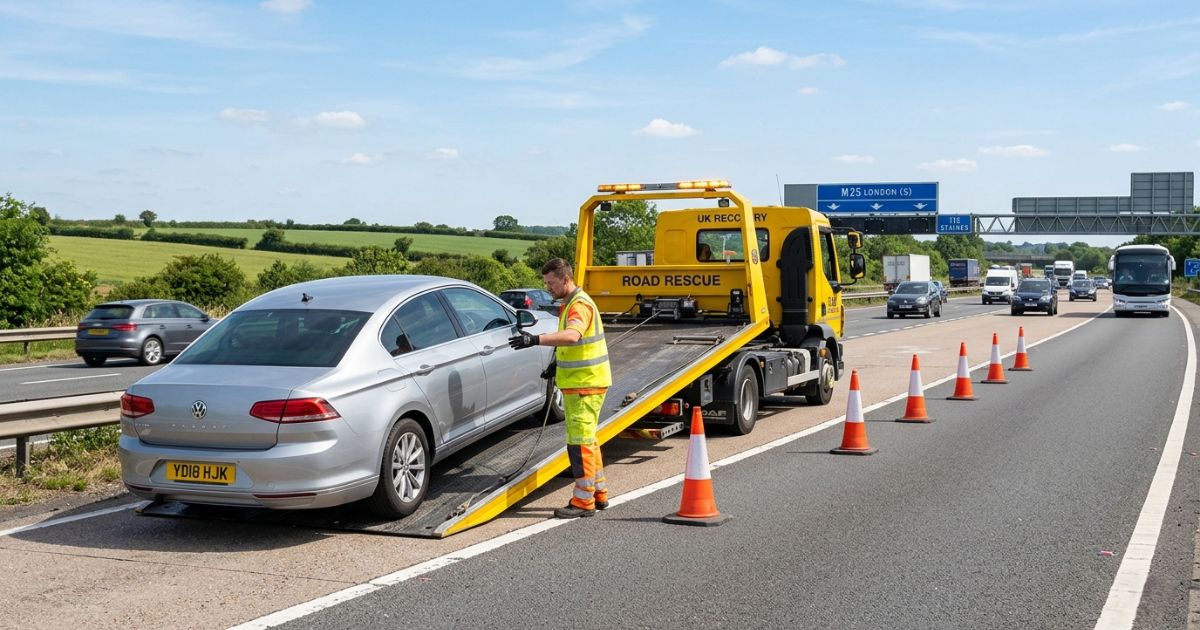
The complete guide to vehicle recovery services in the UK starts with an uncomfortable truth: most drivers do not think about recovery until they are sitting on a hard shoulder in the rain, watching traffic fly past at 70 mph.
I have spoken to hundreds of drivers who wished they had planned ahead. Whether you drive a brand-new electric car or a 15-year-old hatchback, breakdowns and accidents are not a matter of if, but when.
The difference between a 30-minute wait and a three-hour ordeal comes down to one thing: knowing your options before you need them. This guide covers everything from what recovery actually is, to how much it costs, to staying safe on smart motorways.
And if you are involved in an accident that was not your fault, do not let the recovery process add to your stress.
A trusted accident claim company can help you recover not just your vehicle, but also your losses, while you focus on getting back on the road.
What Is Vehicle Recovery? A Clear Definition
Vehicle recovery is the professional process of transporting a broken-down, damaged, or immobile vehicle from one location to another. In the UK, recovery services range from a simple roadside fix (jump start, tyre change) to full flatbed transport across the country.
Unlike standard breakdown cover, which prioritises roadside repairs, recovery focuses on moving your vehicle when it cannot be safely or legally driven.
Recovery vs. Breakdown Cover – What Is the Difference?
| Aspect | Breakdown Cover | Vehicle Recovery |
| Primary goal | Fix the car at the roadside | Move the car to a destination |
| Typical provider | AA, RAC, Green Flag, insurance add-ons | Independent recovery firms, some breakdown providers |
| Cost model | Annual subscription (£40–200) | Pay-as-you-go (£50–300+) |
| Response time | Often faster (contracted networks) | Variable depending on location |
| Best for | Regular drivers, older cars, commuters | One-off emergencies, long-distance transport |
Many breakdown policies include recovery as part of their higher-tier plans. Always check your policy documents before paying out of pocket.
Types of Vehicle Recovery Services
Not all recovery is the same. Here is what you can expect from different service types.
| Service Type | Best For | Typical Distance | Average Cost |
| Local recovery | Breakdown near home or work | Up to 10 miles | £50–150 |
| Long-distance recovery | Moving a car across regions | 50–300+ miles | £1.10–2.50 per mile |
| Motorway recovery | Breakdown on M25, M6, M1, etc. | To nearest exit or service area | Often free to exit, then £50–150 |
| Accident recovery | Vehicle damaged in collision | To storage or repair centre | £100–300 (may be covered by insurance) |
| Specialist recovery | Electric vehicles, classic cars, motorcycles | Variable | £80–250+ |
| Nationwide transport | Buying a non-runner or moving a car | Any distance | £150–600+ |
Motorway Recovery – Special Rules Apply
Breaking down on a motorway is different from any other road. Under UK law, motorway recovery is often provided by Highways England (or equivalent) contractors to clear live lanes quickly.
You may be moved to the nearest exit or service area at no charge. From there, you arrange your own recovery.
Do not call a standard recovery provider directly from a motorway live lane. Call Highways England first (0300 123 5000) or use an emergency SOS phone.
Common Reasons for Vehicle Recovery
Understanding why drivers need recovery helps you avoid becoming one of them.
| Reason | How Common? | Preventable? |
| Flat battery | Very common | Partially (replace every 3–5 years) |
| Flat tyre with no spare | Common | Yes (carry a puncture repair kit) |
| Engine mechanical failure | Moderate | Partially (regular servicing helps) |
| Running out of fuel | Common | Yes (watch your gauge) |
| Misfuelling (petrol in diesel, etc.) | Less common | Yes (pay attention at the pump) |
| Accident damage | Moderate | Partially (defensive driving helps) |
| Electrical fault | Moderate | Partially (regular checks) |
| Overheating | Less common | Yes (check coolant levels) |
Real-world story: Last year, a driver called me from the M25. His “engine management light” had been on for three months. He ignored it.
When his timing chain snapped at 70 mph, he needed a 50-mile recovery and a £2,500 engine rebuild. Early diagnostics would have cost £70.
Step-by-Step – What Happens When You Call for Recovery
Knowing the process reduces panic and helps you get help faster.
Step 1 – You Call
Have this information ready before you dial:
- Your location (postcode, What3Words, or nearest junction/marker post)
- Vehicle make, model, colour, and registration
- Brief description of the problem (“engine won’t start,” “flat tyre,” “smoke from bonnet”)
- Number of passengers (including pets or children)
- Preferred destination (home, specific garage, or service centre)
Step 2 – Dispatcher Assesses
The call handler determines:
- Whether a roadside fix is possible (jump start, spare tyre)
- What type of vehicle to send (flatbed, wheel-lift, motorcycle trailer)
- Urgency level (live lane on motorway = highest priority)
Step 3 – Provider Dispatched
You receive an ETA via text, app, or phone call. In urban areas, this is often 30–60 minutes. In rural areas, 60–120 minutes is common.
Step 4 – Technician Arrives
The technician will:
- Assess the vehicle
- Attempt a roadside fix if safe and possible
- If unsuccessful, prepare the vehicle for recovery
Step 5 – Vehicle Loaded
Modern recovery uses flatbed trucks or wheel-lift systems. Your vehicle is secured with straps or chocks.
Step 6 – Transport to Destination
You have three options usually:
- Your home address
- A local garage of your choice
- A pre-agreed repair centre
You can usually ride in the recovery cab, though space may be limited. If you have passengers or pets, ask the dispatcher to send a vehicle with extra cabin space.
Vehicle Recovery Costs in the UK – Complete Breakdown
Pricing varies wildly. Here is what you should expect to pay in 2026.
Pay-as-You-Go Recovery (No Breakdown Cover)
| Service | Typical Cost | Notes |
| Local recovery (up to 10 miles) | £50–150 | Flat fee plus mileage |
| Per mile beyond 10 miles | £1.50–2.50 | One-way only |
| Motorway recovery (to nearest exit) | Often £0 | Provided by Highways England contractor |
| Motorway recovery (onward from exit) | £50–150 | Then standard mileage rates |
| Out-of-hours surcharge (6pm–8am, weekends, bank holidays) | +£30–100 | Ask before booking |
| Call-out fee (if no work done) | £30–60 | If you cancel after they arrive |
Accident Recovery Costs
If your vehicle is damaged in a collision, recovery costs are often covered by insurance. However:
| Situation | Who Pays | Typical Cost |
| Your fault accident, fully comp insurance | Your insurer (minus excess) | £100–300 |
| Your fault accident, third-party only | You pay | £100–300+ |
| Not your fault accident | Other driver’s insurer (via accident claim company) | £0 to you |
| Stolen vehicle recovered by police | You or your insurer | £100–250 |
If the accident was not your fault, do not pay out of pocket. A reputable accident claim company can handle the recovery costs as part of your claim, ensuring you are not left out of pocket while waiting for reimbursement.
Understanding your insurance protection is equally important after a collision, especially when it comes to injuries and compensation, which is why many drivers also ask: What Is Personal Accident Cover in Car Insurance?
Breakdown Cover – What You Actually Pay
| Provider | Annual Cost (Basic) | Annual Cost (with Recovery) | Excess per call-out |
| AA | £59–89 | £120–200+ | £0–35 |
| RAC | £45–79 | £100–180+ | £0–25 |
| Green Flag | £39–69 | £90–150+ | £0 |
| Insurance add-on | £20–50 | £20–50 (often limited miles) | £0–50 |
If you break down more than once a year, annual cover is almost always cheaper than pay-as-you-go.
Safety While Waiting – A Complete Checklist
Your safety is more important than your car. Follow these steps exactly.
Highway Code Rule 275 – What You Must Do
- Pull over as far left as possible, ideally into an emergency refuge area (on smart motorways)
- Turn on your hazard lights immediately
- Exit the vehicle from the passenger side (away from traffic)
- Move everyone behind a barrier or well away from the carriageway
- Do not stand between your vehicle and oncoming traffic
- Call for help – do not attempt repairs on a live motorway
Smart Motorway Specific Advice
Smart motorways (M25, M6, M1, M62, M42, etc.) have emergency refuge areas (ERAs) every 1.5 miles.
| Situation | Action |
| You reach an ERA | Pull in, use the SOS phone (free, direct to control room). They will close the lane for recovery. |
| You break down in a live lane | Hazard lights on. Call 999 or Highways England (0300 123 5000). Do not exit the vehicle unless in immediate danger (fire, collision risk). |
| Red X lane closure above you | Do not drive in a Red X lane. Cameras enforce a £100 fine and 3 points. |
What to Avoid
- Placing a warning triangle on a motorway (dangerous, not recommended)
- Trying to push your car off the road
- Accepting help from an unverified “good Samaritan” (scams happen)
- Leaving pets alone in the vehicle (they must be kept safe, but do not leave them unattended on a hot day)
Types of Recovery Vehicles – What to Expect
Not all tow trucks are the same. Here is what different vehicles mean for your car.
| Recovery Vehicle | Best For | Risk to Vehicle |
| Flatbed (slide bed) | All cars, especially AWD, low clearance, EVs | Very low – wheels off ground |
| Wheel-lift (underlift) | Front or rear-wheel drive cars | Low – driven wheels lifted |
| Hook and chain | Scrap/salvage vehicles only | High – damages bumpers and suspension |
| Self-loading dolly | Front-wheel drive cars | Low – front wheels on dolly |
Important for electric vehicle owners: EVs should almost always be recovered on a flatbed. Towing with wheels on the ground can damage the electric motor and regenerative braking system. Always tell the dispatcher if you drive an EV.
How to Choose a Reliable Recovery Provider
If you do not have breakdown cover, choosing the right independent provider matters.
Green Flags – What to Look For
| Quality | Why It Matters |
| 24/7 availability | Breakdowns do not happen 9–5 |
| Clear pricing on their website | No hidden surprises |
| Published per-mile rates | Easy to estimate costs |
| Flatbed or wheel-lift fleet | Modern, safe equipment |
| Verified Google reviews (4.0+ stars) | Real customer experiences |
| Local phone number (not just 0800/0333) | Often means local, responsive service |
Red Flags – Walk Away
| Red Flag | Why Risky |
| No price listed anywhere | Likely to inflate charges |
| Cash only, no receipt | No proof of payment, no comeback |
| Unmarked white van with “recovery” in decals | Often uninsured or poorly maintained |
| Vague location (just “London” or “UK-wide”) | May be a call centre reselling to local drivers |
| Asking for payment before arrival | Unusual and high-risk |
Questions to Ask Before Booking
- “Are you available 24/7, including tonight?”
- “What is your estimated arrival time for my postcode?”
- “Do you use flatbed or wheel-lift trucks?”
- “Can you recover my specific vehicle [make/model/year]?”
- “What is the total cost including VAT to my destination?”
- “Do you charge per mile or a flat fee?”
- “Can you take me and my passengers in the cab?”
2026 Updates – What Has Changed for Vehicle Recovery
The recovery industry has evolved. Here are the key 2026 updates.
Electric Vehicle (EV) Recovery Standards
From 2026, all professional recovery providers in the UK are encouraged (and in some areas required) to have EV-specific training. Key changes:
- EV recovery must use flatbed trucks only
- Technicians carry insulated gloves and EV-safe extinguishers
- Some insurers now refuse to cover non-EV-trained recovery for EV breakdowns
If you drive an EV, ask your recovery provider about their EV certification before you need them.
Smart Motorway Rollback
Following safety concerns, the UK government has paused new smart motorway conversions and is adding more emergency refuge areas.
However, existing smart motorways remain. Recovery on these roads is now prioritised, with average response times under 30 minutes in live lane situations.
What3Words Integration
Most major recovery providers now accept What3Words locations. This 3m x 3m grid reference is far more accurate than a postcode for rural breakdowns. Download the free app before you travel.
Digital Tracking
Almost all professional recovery providers now offer live tracking via SMS or app. You can see your recovery vehicle’s location and ETA in real time. If your provider does not offer this, consider another.
Printable Emergency Checklist
Cut this out or save it to your phone.
Before you drive:
- Save a local recovery number in your contacts
- Check your breakdown cover or insurance policy
- Download What3Words
- Keep a phone charger in your car
If you break down:
- Pull over safely, hazard lights on
- Exit from passenger side, behind barrier
- Call your recovery provider or Highways England (0300 123 5000 on motorways)
- Have your location, reg, and problem ready
- Ask for ETA and cost before agreeing
After the call:
- Stay behind barrier
- Keep passengers together
- Do not accept help from strangers
- Wait for the professional
If you have suffered injuries in a collision, understanding the Personal Injury Claim Process can help you recover compensation more smoothly while your vehicle recovery and repairs are being handled.
Final Thoughts
The complete guide to vehicle recovery services in the UK ends where most drivers start: sitting in a broken-down car, watching the rain, wondering how long it will take.
You can avoid that panic by spending 10 minutes today preparing. Check your breakdown cover. Save a local recovery number. Download What3Words. Know where your car’s emergency kit is.
And if the worst happens – if you are in an accident that was not your fault do not let the aftermath add to your stress. Your vehicle recovery should be handled professionally and at no cost to you.
A trusted accident claim company can manage the entire process, from recovery to repair to compensation, so you can focus on what matters most: getting back behind the wheel safely.