
In the history of oncology, we have gradually transitioned from the era of “carpet bombing” chemotherapy to the era of “precision sniping” targeted therapy. Nowadays, a new class of targeted radiopharmaceuticals known as Radionuclide Drug Conjugates (RDCs) is rapidly gaining attention in oncology research and global biomedicine due to its unique advantages in theranostics—the integration of diagnostics and therapeutics.
From Radiotherapy to Radioligand Therapy: The Rise of Radionuclide Drug Conjugates
Conventional radiotherapy (RT) usually relies on external irradiation. Although it can kill cancer cells, it may also damage adjacent healthy tissues at the same time. Radioligand Therapy (RLT) achieves precise energy delivery by combining targeted molecules with radionuclides.
An RDC is typically designed to combine two key components:
- Targeting Ligand: A molecule such as an antibody, peptide, or small molecule that recognizes specific antigens on tumor cells.
- Radionuclide: It is responsible for releasing high-energy rays that cut the DNA strands of cancer cells at extremely short distances.
By limiting radiation to the tumor microenvironment, RDC is able to significantly reduce systemic toxicity, offering transformative survival hope for patients with advanced or metastatic malignancies.
Key Challenges in RDC Development: Stability and Biodistribution
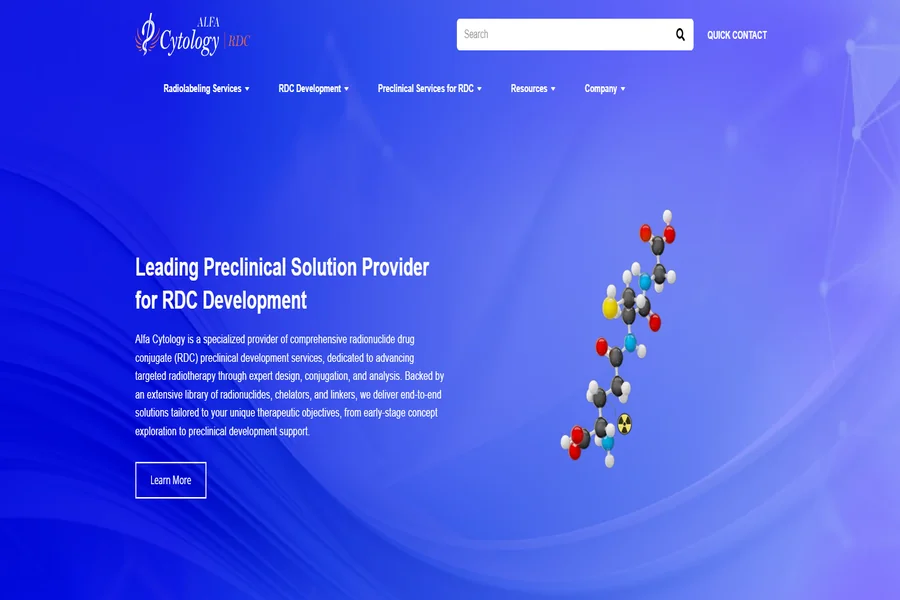
Despite the promise of RDC, the threshold for research and development is extremely high. The core challenge is the Radiopharmaceutical Stability and Biodistribution. To overcome these challenges, Alfa Cytology has established a specialized RDC development platform to provide global customers with a one-stop solution from early detection and design to coupling and pre-clinical evaluation. The platform supports a broad range of RDC development services, including targeting ligand design, radionuclide conjugation, chelator and linker optimization, as well as in vitro and in vivo evaluation. These integrated capabilities help researchers accelerate radiopharmaceutical discovery and reduce the risks associated with early-stage development.
In order to improve the success rate of research and development, the platform has invested a large amount of technical resources in key technical links:
- Full Range of Coupling Capabilities: Not limited to the traditional radionuclide antibody conjugate (ARC), but also covers the development of radionuclide peptide conjugate (PRC), small molecule conjugate (SMRC), and siRNA vector, so that the most appropriate delivery vector can be customized according to the biological characteristics of different tumors.
- Sophisticated Component Optimization: The platform provides customized chelator screening and linker synthesis services to solve the possible toxicity problems caused by radionuclide dissociation. Through the in-depth understanding of coordination chemistry, RDC molecules can still remain highly stable in a complex physiological environment.
- Rigorous Evaluation Model: Using advanced in vitro and in vivo experimental systems, subcellular distribution studies, endocytosis/release experiments, and detailed in vivo distribution and dosimetric evaluation were carried out. These comprehensive tests ensure that the pharmacokinetic profile is adequately validated before proceeding to the clinical stage.
Theranostics in Oncology: The Expanding Applications of Radioligand Therapy
The current cancer drug development pipeline is showing an obvious trend of Theranostics. By replacing the radionuclide in the RDC, physicians can use the same targeting ligand to first perform diagnostic imaging to confirm drug enrichment in vivo, and then switch to a therapeutic radionuclide for precision strikes.
This model not only optimizes clinical decision-making but also significantly improves the success rate of drug development. To support this trend, Alfa Cytology offers a wide range of application services, including cancer treatment, diagnostic imaging, and BNCT development, to help research and development institutions shorten the time from candidate screening to practical application.
Future Prospects: Market Access and Accessibility
With the approval of a variety of RDC drugs, the market access strategy of radiopharmaceuticals has become a hot topic in the industry. Unlike common drugs, the production of RDC is strictly limited by the half-life of the radionuclide.
Fortunately, the RDC R&D process is becoming more efficient and predictable as specialized platforms such as Alfa Cytology with rich nuclide libraries continue to mature. This comprehensive technical support is accelerating RDC from the laboratory to the clinic.
Conclusion
The emergence of radionuclide drug conjugates indicates that tumor therapy is changing from “finding drugs” to “designing precision strike systems”. RDC is not only a technological breakthrough, but also a deep respect for the quality of life of patients, which makes those tiny metastases that were difficult to control by surgery become “clearly visible” and “precise and treatable”.
However, the success of RDC is no accident; it depends on the deep intersection between chemistry, biology, and nuclear medicine. In this complex R&D chain, specialized partners like Alfa Cytology play an integral role. With a rich nuclide resource library and customized development process, the platform is working hard to break down the research and development barriers and translate complex nuclear medicine technologies into practical clinical protocols.
Looking forward, with the application of radioligand therapy in more solid tumors and the continuous optimization of market access strategies and supply chains, it is reasonable to believe that RDC will become one of the mainstream modes of cancer treatment in the next decade. In this war against time, more precise strikes, fewer side effects, and more efficient research and development platforms will be the solid foundation on the road to a cure.