
Picture your current server room or network closet. Is it a neat, labeled environment where every cable has a clear destination? Or does it look like a bowl of spaghetti exploded inside a closet?
For many growing businesses in the Dallas-Fort Worth Metroplex, the latter is an unfortunate reality. When you first started, running a single Ethernet cable from a router to a desk seemed sufficient. But as your team grew, so did the cables. Now, you’re left with a tangled web of “spaghetti wires” that aren’t just an eyesore—they are a liability.
Haphazard wiring creates significant safety risks, obstructs airflow to critical equipment, and makes troubleshooting network outages a nightmare. As operations scale, this lack of organization transforms from a minor annoyance into a major bottleneck. To avoid the chaos of “spaghetti wires,” forward-thinking companies rely on structured network cabling solutions in Dallas that prioritize organization and future growth.
This guide explains why structured cabling is the only scalable choice for modern businesses and exactly how to find a certified partner to install it correctly.
Structured Cabling vs. “Spaghetti” Wiring: What’s the Difference?
To understand the value of a professional solution, we first have to look at the alternative: the chaotic approach that plagues so many offices.
The Risks of Point-to-Point Cabling
The “old way” of doing things is often referred to as point-to-point cabling. This happens when a technician runs a direct patch cord (or “jumper”) from one piece of hardware directly to another without a central plan. It’s the quick fix. It’s the “I just need this computer to work right now” method.
While it might work for a home office, it is unsustainable for a business. Over time, these individual cables accumulate. The result is the dreaded “Spaghetti Closet.” In this environment, troubleshooting is virtually impossible because no one knows which wire goes where. If a server goes down, your IT team has to physically trace cables through a tangled mess, wasting hours of critical time.
Beyond the frustration, this method creates genuine physical risks:
- Overheating: Dense, messy bundles of cables block airflow to servers and switches, leading to hardware failure.
- Safety Hazards: Loose cables on the floor are tripping hazards, and tangled wires behind walls can violate fire codes.
The Structured Solution
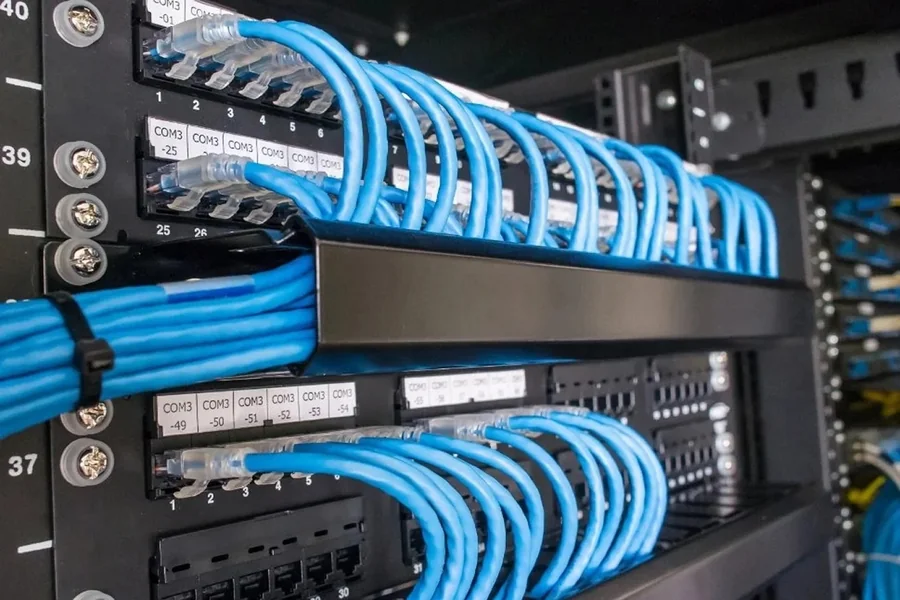
Structured cabling is the exact opposite of the point-to-point method. It is a standardized architecture that uses a system of patch panels, trunks, and twisted pairs to create a comprehensive telecommunications infrastructure. Think of it as building a highway system for your data rather than just driving over dirt roads.
The defining characteristic of a professional solution, like those offered by JabberComm, is the “Clean and Organized” aesthetic. In a structured system:
- Cables are Bundled: Wires are neatly grouped and routed through cable management tools.
- Everything is Labeled: Every port, jack, and patch panel is clearly labeled, meaning you know exactly where every connection leads.
- Hidden Infrastructure: The bulk of the cabling is hidden safely behind walls or in ceiling plenums, leaving your office looking professional.
The operational benefit is immediate. Moves, Adds, and Changes (MACs) become simple tasks. If you hire a new employee or move a department to a different floor, you don’t need to run new wires across the building. You simply patch into the existing structured network.
The Business Case: Why Invest in Professional Cabling?
For a Scaling Operations Leader or CFO, the decision to upgrade infrastructure often comes down to ROI. Why spend the money on a professional installation now? The answer lies in risk mitigation and future-proofing.
Minimizing Costly Downtime
Reliability is a financial metric, not just a technical one. When your network goes down, your employees stop working, sales calls drop, and operations grind to a halt.
If your network closet is a mess, a simple loose connection could take two hours to find and fix. That is two hours of lost revenue. In a structured cabling environment, that same issue could likely be identified and resolved in minutes because the infrastructure is logical, labeled, and accessible. The upfront cost of professional cabling acts as an insurance policy against expensive, extended outages.
Future-Proofing for Scalability
We are currently witnessing an explosion of connected devices. From high-speed Wi-Fi 6 access points to IoT (Internet of Things) sensors and 5G integration, the demands on your network backbone are higher than ever.
If you install cheap cabling today, you will likely have to rip it out in three years when it can’t handle the bandwidth requirements of new technology. JabberComm focuses on installing a robust backbone—typically using high-quality Cat6, Cat6a, or Fiber Optic cabling—that is designed to handle the data loads of tomorrow. This allows your business to scale its tech stack without requiring a complete facility rewire.
How to Choose a Dallas Provider: The Importance of Certification
Not all cabling contractors are created equal. In the Dallas-Fort Worth area, you will find everything from general handymen to specialized network architects. How do you distinguish the professionals from the amateurs?
Why BICSI Certification is Non-Negotiable
The most critical differentiator is certification. Your cabling infrastructure is a utility, just like your electricity and plumbing. You wouldn’t hire an unlicensed electrician to wire your building, and you shouldn’t hire an uncertified technician for your network.
Specifically, you need to look for BICSI certification. BICSI certification ensures that technicians adhere to the highest global standards for information and communications technology (ICT) installation.
Contractors who lack this training may violate local building codes, use substandard materials, or run cables near electrical lines that cause signal interference.
JabberComm differentiates itself by employing BICSI-certified technicians and Registered Communications Distribution Designers (RCDD). This means every cable run, every termination, and every pathway is designed to meet strict industry standards for safety and performance. When you see the RCDD designation, you know the design is compliant with the National Electrical Code (NEC) and telecommunications standards.
What to Expect During the Installation Process
Demystifying the installation process helps you plan your operations around the upgrade. A professional engagement with JabberComm typically follows four distinct phases.
Phase 1: Design & Site Survey
Before a single cable is cut, the team conducts a comprehensive site survey. They assess your floor plan, identify the best locations for Main Distribution Frames (MDF) and Intermediate Distribution Frames (IDF), and map out the optimal routes for cable pathways. This is where the RCDD expertise shines, ensuring the design supports your current headcount and future growth.
Phase 2: The Rough-In
This is the physical installation phase. Technicians install the backbone cabling behind walls, above ceilings, and through floor ducts. This phase emphasizes the “hidden wires” aesthetic. The goal is to route all infrastructure efficiently while keeping it completely out of sight and out of harm’s way.
Phase 3: Termination & Standardization
Once the cables are run, they are terminated at the patch panels in the server room and the wall jacks at the workstations. This is where the organization happens. Cables are dressed (neatly bundled), velcroed, and, most importantly, labeled according to the design plan.
Phase 4: Testing & Certification
The job isn’t done until it’s tested. Professional installers use high-end Fluke testing equipment to verify signal integrity, speed, and continuity for every single line. You receive a certification report proving that your new network meets the required Category (Cat5e, Cat6, Fiber) standards.
Conclusion
Your network infrastructure is the nervous system of your business. If it is disorganized, fragile, or outdated, your entire operation slows down. You simply cannot afford to let “spaghetti wiring” become the bottleneck that stifles your growth.
By investing in a professional structured cabling solution, you gain more than just a clean server room. You gain the peace of mind that comes with BICSI-certified safety, the financial protection of reduced downtime, and the flexibility to scale your technology for years to come.