
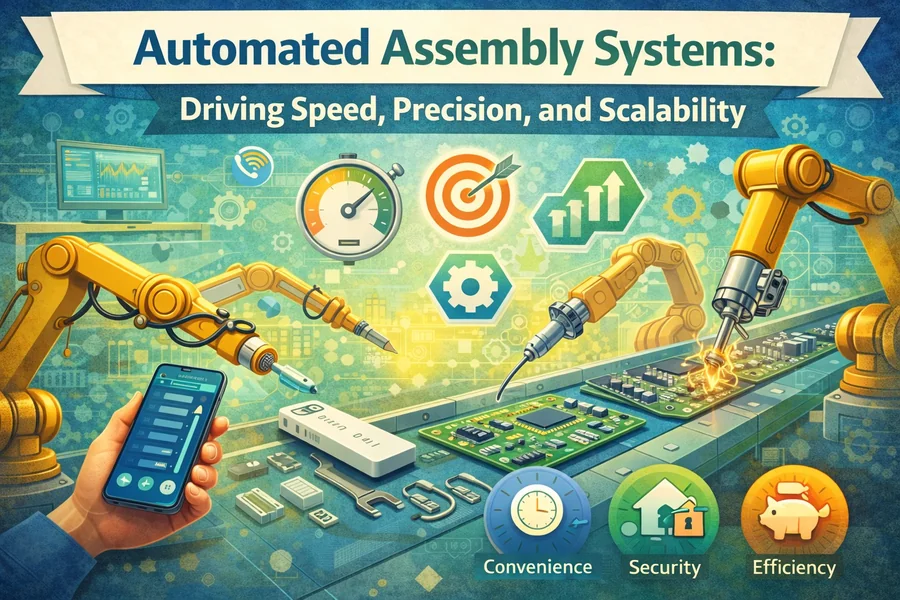
Modern manufacturing is no longer defined by manual labor alone. As global demand rises and product life cycles shorten, manufacturers are under constant pressure to deliver faster, maintain accuracy, and scale without sacrificing quality. Automated assembly systems have emerged as a core solution to these challenges, transforming how products are built, tested, and delivered across industries.
From electronics and automotive production to medical devices and consumer goods, automation has become a strategic investment rather than a technical upgrade. Understanding how these systems work and why they matter can help decision-makers stay competitive in an increasingly demanding marketplace.
Understanding Automated Assembly Systems
Automated assembly systems refer to integrated setups where machines, robotics, control software, and sensors work together to assemble components with minimal human intervention. Unlike traditional production lines, these systems rely on programmable logic and repeatable processes to ensure consistent output.
At the heart of these systems is coordination. Each station performs a specific task, such as part placement, fastening, welding, inspection, or packaging. When designed correctly, the entire system functions as a synchronized unit, reducing errors and maximizing throughput.
A modern automated assembly line often combines robotics, conveyors, vision systems, and data feedback loops to create a highly responsive production environment. This approach allows manufacturers to maintain control over quality while accelerating production speeds.
The Role of Speed in Modern Manufacturing
Speed is one of the most visible advantages of automation. Manual assembly processes are limited by human endurance and variability. Automated systems, on the other hand, operate continuously with consistent cycle times.
Key speed-related benefits include:
- Faster production rates without compromising accuracy
- Reduced downtime through predictive maintenance
- Seamless transition between production stages
- Ability to meet tight delivery schedules
An Intelligent Assembly Line takes speed a step further by adapting to changes in real time. Sensors and control software monitor performance, detect bottlenecks, and adjust workflows automatically. This level of responsiveness ensures that speed does not come at the expense of reliability.
Precision That Protects Product Quality
Precision is critical in industries where even minor deviations can lead to product failure or safety risks. Automated systems excel in this area by executing tasks with exact measurements and controlled force.
Robotic arms, for example, can place components within microns of tolerance. Vision systems verify alignment, orientation, and presence of parts before the process moves forward. This reduces defects and minimizes the need for rework.
An automated assembly system ensures that every unit meets the same specifications, regardless of production volume. Consistency like this is difficult to achieve through manual labor alone, especially in high-volume environments.
Precision-driven benefits include:
- Lower defect rates
- Improved compliance with industry standards
- Reduced material waste
- Enhanced brand reputation through reliable products
Scalability for Growing Businesses
Scalability is often the deciding factor when companies evaluate automation. As demand increases, manual processes struggle to keep up. Hiring and training new workers takes time, and quality can vary as teams expand.
Automated assembly systems are designed with scalability in mind. Modular components allow manufacturers to add stations, upgrade software, or integrate new technologies without redesigning the entire line.
For example, an automated assembly line can be expanded to handle additional product variants or higher output by adjusting programming and adding compatible modules. This flexibility supports long-term growth while protecting initial investments.
Scalable automation also helps businesses respond quickly to market shifts, seasonal demand, or new product launches.
How Intelligent Systems Enhance Decision-Making
Traditional automation follows predefined instructions. Intelligent systems go further by learning from data. An Intelligent Assembly Line uses real-time analytics to optimize performance continuously.
Data collected from sensors and controllers provides insight into:
- Cycle times and throughput
- Equipment health and wear
- Quality trends and defect patterns
- Energy consumption
With this information, manufacturers can make informed decisions that improve efficiency and reduce costs. Predictive maintenance, for instance, helps prevent unexpected downtime by identifying issues before they cause failures.
This intelligence turns automation into a strategic asset rather than just a mechanical tool.
Integration With Digital Manufacturing Ecosystems
Automated assembly systems do not operate in isolation. They are increasingly connected to broader digital manufacturing ecosystems that include enterprise software, inventory management, and supply chain platforms.
Integration enables seamless communication between production and planning. When an order is placed, the system can adjust schedules, allocate resources, and track progress automatically.
Key integration advantages include:
- Real-time production visibility
- Better inventory control
- Faster response to customer demands
- Improved coordination across departments
By connecting an automated assembly system to digital platforms, manufacturers gain end-to-end control over their operations.
Workforce Transformation and Skill Evolution
Automation does not eliminate the need for human expertise. Instead, it reshapes roles and skill requirements. Workers move from repetitive manual tasks to higher-value responsibilities such as system monitoring, programming, maintenance, and process optimization.
This transformation benefits both employees and employers. Workers gain opportunities to develop technical skills, while companies benefit from improved efficiency and reduced turnover.
Successful implementation often includes:
- Training programs for operators and technicians
- Clear communication about role changes
- Collaboration between engineering and production teams
When people and machines work together effectively, automation becomes a tool for empowerment rather than replacement.
Cost Efficiency and Long-Term Value
While the initial investment in automated assembly systems can be significant, the long-term financial benefits are substantial. Reduced labor costs, lower defect rates, and improved efficiency contribute to a strong return over time.
Cost-related advantages include:
- Consistent output with fewer resources
- Reduced scrap and rework expenses
- Lower warranty and recall risks
- Improved energy efficiency
An automated assembly line delivers predictable performance, making it easier to forecast costs and plan future investments.
Industry Applications and Use Cases
Automated assembly systems are widely used across multiple sectors due to their adaptability and reliability.
In automotive manufacturing, they support high-speed assembly of complex components. In electronics, they handle delicate parts with extreme precision. Medical device manufacturers rely on automation to meet strict regulatory requirements, while consumer goods producers use it to maintain consistency at scale.
Each application benefits from the same core principles: speed, precision, and scalability tailored to specific production needs.
Choosing the Right Automation Strategy
Not all automation solutions are the same. Selecting the right system requires a clear understanding of production goals, product complexity, and future growth plans.
Important considerations include:
- Current and projected production volumes
- Product variation and customization needs
- Available space and infrastructure
- Integration with existing systems
Working with experienced automation partners helps ensure that the solution aligns with both technical and business objectives.
Why Automation Is Shaping the Future of Manufacturing
Manufacturing is entering an era defined by adaptability and intelligence. Companies that invest in automation today position themselves to compete tomorrow.
An automated assembly system provides the foundation for innovation, allowing businesses to experiment with new designs, materials, and processes without disrupting operations. Combined with intelligent controls and scalable architecture, automation becomes a driver of long-term success.
Looking Ahead to Smarter, Faster Production
Automated assembly systems are more than a response to current challenges. They represent a forward-looking approach to manufacturing that prioritizes efficiency, consistency, and growth. By embracing automation, manufacturers can build resilient operations capable of evolving with market demands while delivering high-quality products at scale.